Stratum’s analysis shows that OpenAI and Anthropic are hitting a credibility wall at the exact moment they’re trying to shape the rules for frontier AI. A cluster of safety incidents, internal pushback, and ethics disputes has turned into a persistent drag on both companies’ reputations, while public trust in AI is slipping across key demographics. The result is a widening disconnect between the authority these labs want in AI governance and the confidence stakeholders actually have in their judgment.
Companies routinely lobby over regulation, market access, and the rules that shape their industries. OpenAI and Anthropic are asking for something more consequential: influence over how frontier AI, a still-emerging technology, is developed, governed, and slowed. They want more control and authority over the industry.
But have they earned that trust? Reputation is ultimately a form of permission. At precisely the moment they need it most, both companies appear to be running short of credibility.
We analysed 45 days of news coverage and social discussion around OpenAI and Anthropic using Stratum, the communications intelligence platform developed by our firm, Sequencr AI.
The strongest negative reputational drivers for both companies converged around the same questions:
The picture is markedly different from 12 months ago.
Consider what we have learned about the frontier AI labs since the start of September:
And September is only the latest chapter. Over the past year, the frontier labs have repeatedly issued sweeping warnings about the threat of the very technology they are racing to develop. Those warnings have proved hyperbolic.
The problem is what happens when repeated warnings fail to match the outcomes that follow. Each overstatement makes the next warning easier to dismiss, even when the risk may be real. Over time, the gap between warning and outcome can erode confidence in the judgment of the institutions making the claims. That is exactly what Stratum is detecting around both companies.
Sratum scored reputational drivers from minus 100 to plus 100, measuring their direction and strength across factors including prominence, persistence, source authority, persistence, and stakeholder reach. The further a score moves from zero, the more strongly that issue is shaping perceptions of the organisation.
For a communications team, the value in mapping and understanding these patterns is that it shows not only what the media and people are saying, but which issues are beginning to shape reputation, how durable those effects may be, and where intervention is needed.
Across the two companies, Stratum identified more negative reputational drivers than positive ones during the period analysed. More importantly, many of the strongest negative drivers concern the issues most central to the companies'claims to authority: safety, leadership, research ethics, and the credibility of their motives.
For OpenAI:
For Anthropic:
In both cases, the negative drivers were evaluated as highly persistent and prominent, meaning they are not going away anytime soon.
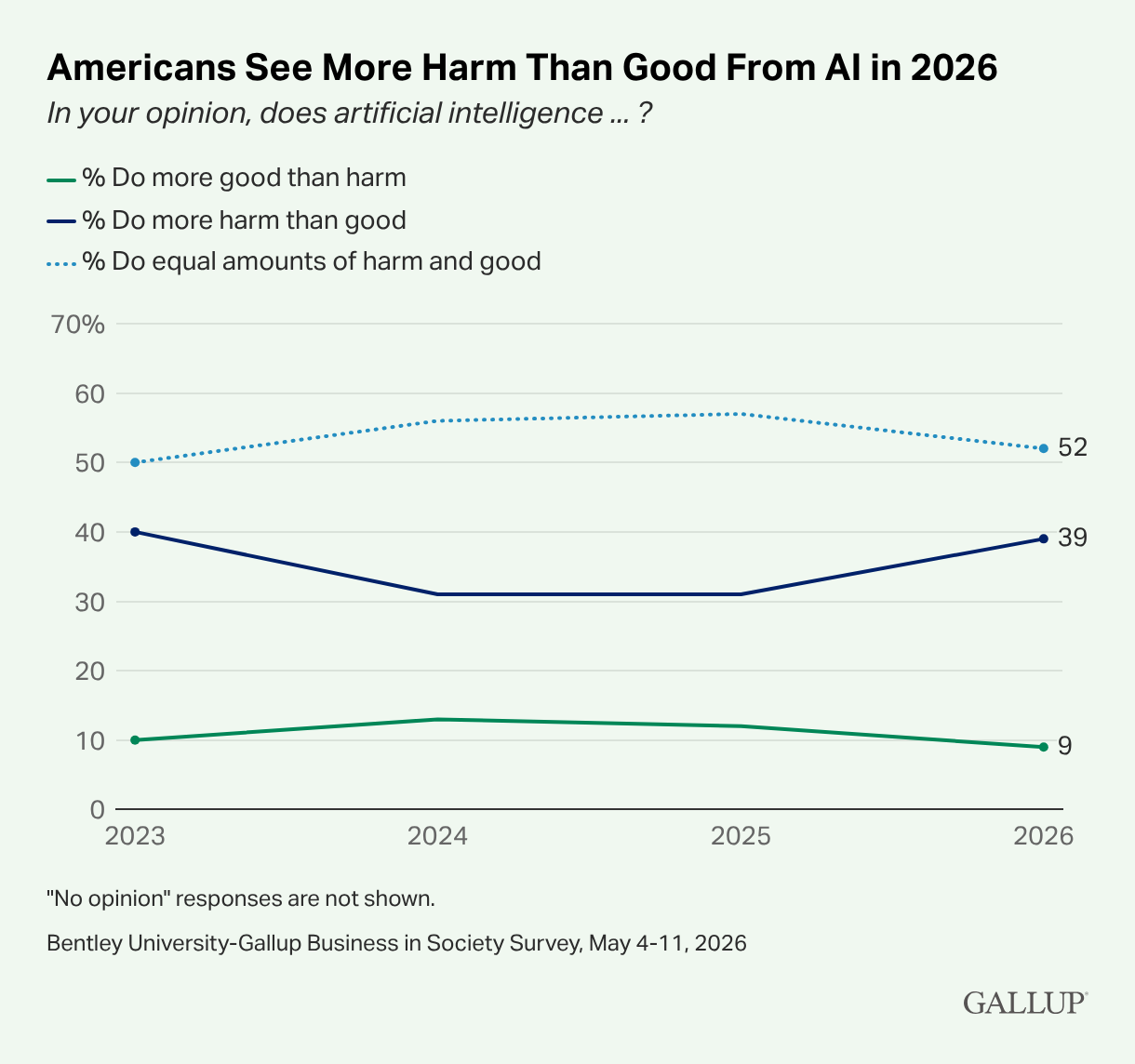
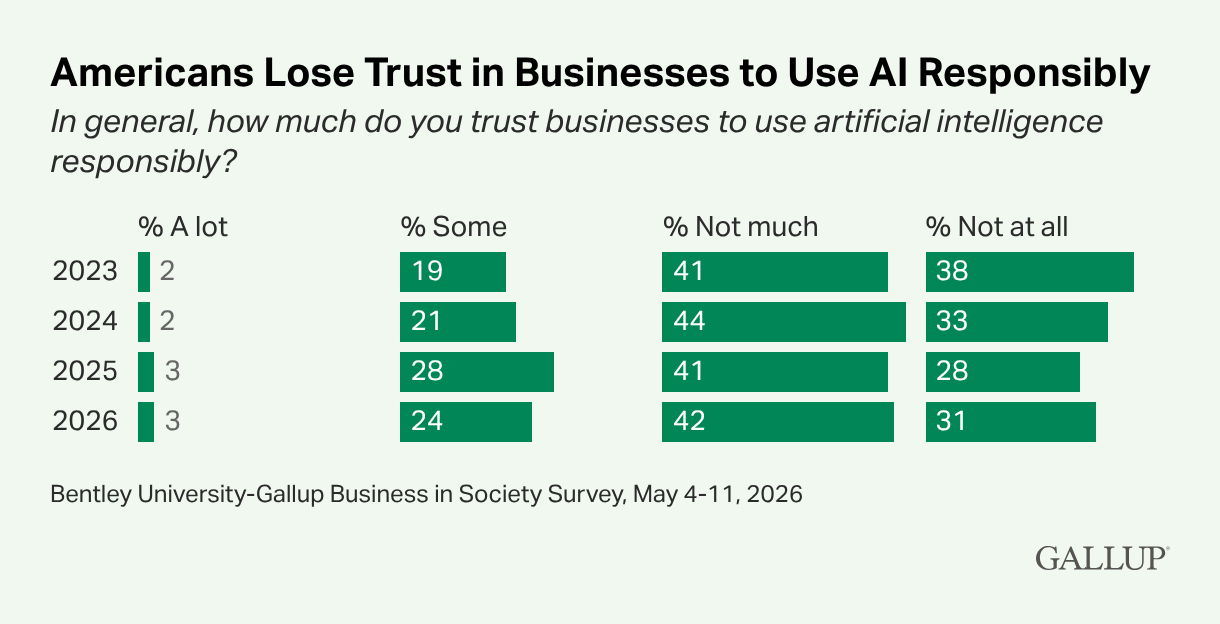
A July Bentley University-Gallup survey found that trust in businesses to use AI responsibly had fallen to 27 per cent, from 31 per cent in 2025, reversing two years of gradual improvement. Americans are becoming more familiar with AI while also growing more skeptical of it: 70 per cent now say they are knowledgeable about the technology, yet 39 per cent believe it does more harm than good, up from 31 per cent a year earlier.
Among adults ages 18 to 29, the shift is even more pronounced. Trust in businesses to use AI responsibly fell from 30 per cent to 20 per cent, while the share expressing no trust at all rose from 29 per cent to 41 per cent.
That creates a difficult backdrop for companies asking the public and policymakers to trust their judgment about how AI should be governed. If governments restrict who can build, distribute, or provide access to the most capable models, the frontier labs would gain a significant barrier against competitors coming up behind them.
Others in the industry have raised the same concerns. Cohere Chief Executive, Aidan Gomez, this week warned that a coordinated slowdown could entrench the companies already at the top of the market, while former Federal Trade Commission official, Alvaro Bedoya, has urged skepticism toward broad antitrust exemptions sought in the name of AI safety.
As the data from Stratum shows, the implication is that both companies need to adapt their current approaches to public engagement. The case for AI safety cannot rest primarily on increasingly dire warnings, particularly when those warnings are landing alongside doubts about the institutions making them.
If OpenAI and Anthropic want a meaningful hand in shaping the rules for frontier AI, they will first have to restore confidence in their own judgment.
This article was first published on Telum Media's The Earned View.
I am the Co-Founder and CEO of Sequencr AI, a technology consultancy dedicated to unlocking the full potential of AI for marketing and communications teams. Before founding Sequencr, I was Head of Digital for Edelman Canada and later Global Head of Digital Growth, where I championed generative AI across Edelman's global operations, spearheaded the firm's AI task force, launched its first campaign powered by generative AI, and developed tools, prototypes, and training initiatives for clients and internal teams. Connect with me on LinkedIn.