





How AI Systems Source, Analyse, and Recommend Brands: The Executive Guide to AI Reputation Intelligence
Generative AI is rapidly evolving from a search directory into an active interpreter and recommender of corporate information. While ranking #1 on Google remains valuable, buyers increasingly form brand perceptions upstream inside ChatGPT, Perplexity, Copilot, and Google AI Overviews. Here is how large language models evaluate organisations—and how communications leaders can audit and shape the outcome.

AI Generated Summary:
AUDIO FILE DOWNLOAD- The article explains how generative AI and answer engines source, evaluate, and recommend organisations—and why traditional SEO rankings are no longer enough to protect or build corporate reputation.
- Rather than simply returning lists of links, systems like ChatGPT Search, Perplexity, and Google AI Overviews retrieve passage fragments, weigh source credibility across six interconnected pillars, and construct synthesised narratives or commercial shortlists before a buyer ever visits a company's website.
- To manage this shift, communications leaders must move beyond counting AI mentions and adopt an ongoing AI Reputation Intelligence framework that comprises: discovering, interpreting, and influencing the third-party evidence that shapes how AI understands and recommends their brand or company.
Communications teams have long understood that reputation depends on what influential voices say about a company. The same principle now applies to generative AI. Where a company ranks or how often it is cited matters far less than how AI models "think" about it, and what informs those judgements.
Further to an earlier piece fiirst published on The Earned View by Telum Media, we've established the importance of incorporating generative AI monitoring and engagement within an integrated corporate marketing and communications strategy. Here, we'll dive a little deeper into how AI discovers and synthesises information about your brand or company.
1. From Ranked Links to Synthesised Recommendations
To understand AI reputation and how to audit it properly, communications and marketing leaders must look beyond traditional SEO and ask a more fundamental question: How does an AI system decide what it knows about an organisation, which sources it trusts, what information it considers relevant, and ultimately what it tells someone about that organisation?
Traditional search engines primarily act as directories and are essentially used for helping people locate web pages so they can click through and evaluate credibility themselves. AI-powered answer engines such as ChatGPT Search, Perplexity, Claude, and Google AI Overviews go a step further: they retrieve passage fragments, interpret meaning, connect facts across competing sources, assess suitability, and generate a synthesised recommendation.
What this means is that AI is now a key piece that has the ability to change a perception or opinion of a brand or company.
From simply a visibility perspective, UK regulator Ofcom highlights in The Era of Answer Engines that single-answer synthesis dramatically narrows the number of sources visible to buyers. A company can rank #1 on Google for core category terms and still be misrepresented in ChatGPT, omitted from Microsoft Copilot shortlists, or overshadowed by competitors with stronger third-party evidence.
AI reputation is about how it is perceived and evaluated. AI recommendation is about whether it is considered a credible choice.
2. The Six Pillars of How AI Evaluates Brands
There is no universal ranking formula for AI models. Rather than using fixed weights for factors like authority or freshness, models assess information through a combination of six operational pillars and five key evaluation dimensions: Relevance, Credibility, Information Quality, Freshness & Consistency, and Suitability. Explore each pillar below.
Query Fan-Out: How AI Interprets Information About Your Company Across Sources
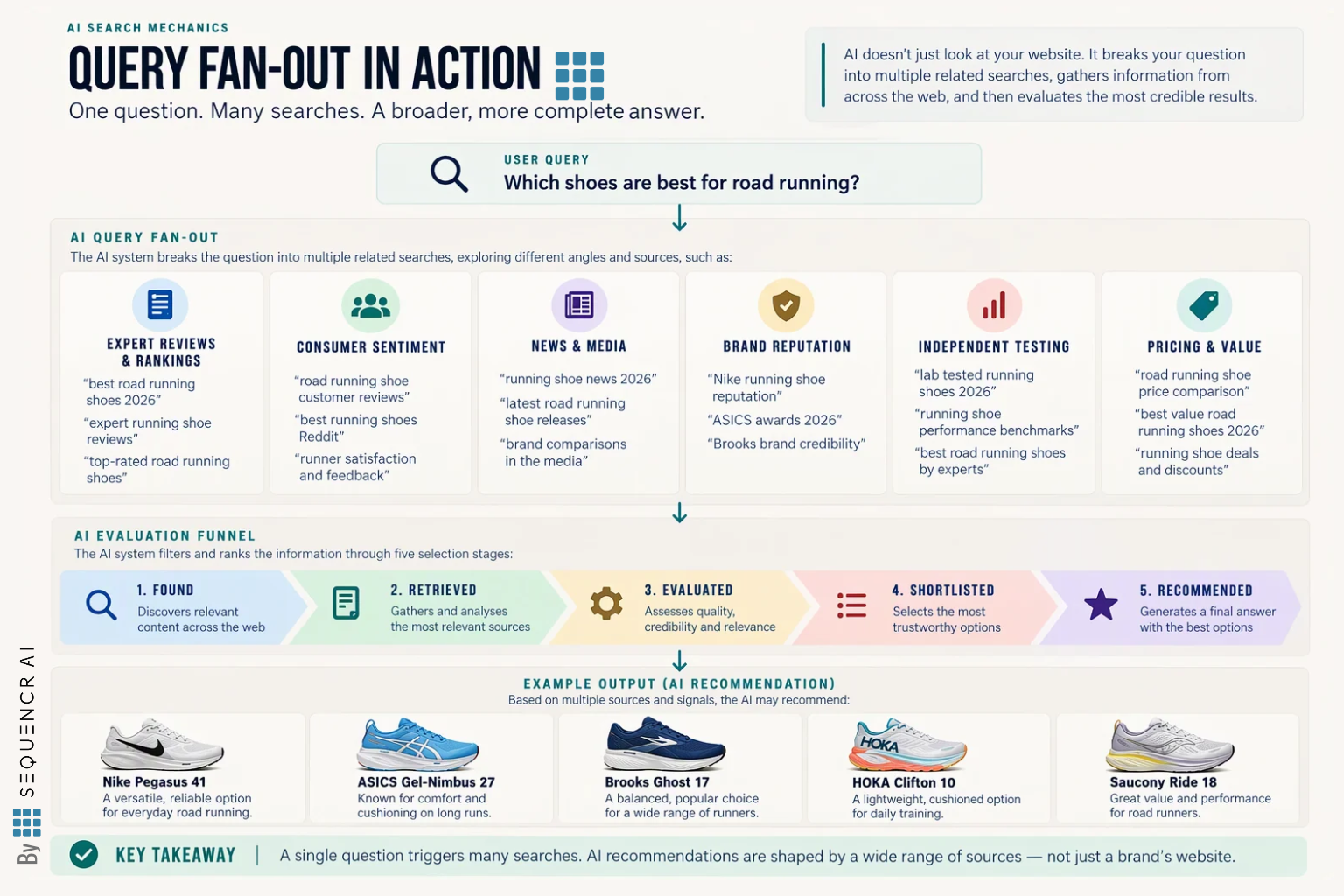
AI systems don't just look at your website. When someone asks about your company, the AI breaks the question into multiple related searches, checking sources such as reviews, news coverage, awards, leadership profiles, customer feedback, and pricing information. Your brand is then assessed through a selection process funnel: Found → Retrieved → Evaluated → Shortlisted → Recommended. This means your reputation across the wider web can influence AI recommendations as much as, or more than, your own website. It asks questions in relation to the user's main query, such as: Which shoes are best for road running?
It goes out to perform the research based on several sub-queries and performs multiple searches around:
- Expert reviews
- Customer reviews
- News and media
- Brand reputation
- Independent testing
- Pricing and value
3. Divergent Search Indices & Where AI Gets Its Citations
Different AI platforms draw information from different search ecosystems. While the sources may vary, AI systems generally favour information that demonstrates authority, expertise, evidence, recency, consistency, and transparency.
This analysis is informed by one of the industry's largest AI citation datasets, Muck Rack’s Generative Pulse, encompassing more than 40 million AI responses and 207 million citations, complemented by a September benchmark of 1,020 prompts tested across ChatGPT, Claude, Gemini, and Perplexity.
4. What Companies Can Control: Four Levers vs. GEO Quick Fixes
Organisations shape AI perception across four controllable domains: Owned Media (server-rendered HTML, direct-answer opening passages, clear service taxonomies), Earned Media (independent trade journalism, analyst recognition, capturing the 7-day post-publication news peak), Shared Media (verified customer reviews, specialist communities, YouTube explainers), and Organisational Evidence (named client case studies, audited disclosures, certifications).
Crucially, Google's search guidance explicitly warns against artificial "Generative Engine Optimisation" shortcuts, including llms.txt files (which 2026 audits of 300,000 domains show have no measurable correlation with AI citations), contrived content chunking, and scaled fan-out spam pages. By contrast, peer-reviewed research (Aggarwal et al., ACM KDD) proves that verifiable evidence drives measurable citation gains:
Source: Research by Aggarwal et al. (ACM KDD) found that evidence-based content such as quotations, statistics, and citations increased visibility in AI-generated responses, while keyword stuffing reduced visibility by approximately 8%. Findings are drawn from the Generative Engine Optimisation (GEO) benchmark study, which evaluated how different content attributes influence citation and recommendation rates in AI search systems. Reference: CXL, "Generative Engine Optimization (GEO): What It Is and What the Research Says Works"
5. Sequencr’s Methodology: AI Reputation Intelligence
AI outputs are inherently non-deterministic and can vary based on model updates, retrieval state, and prompt phrasing. What we look at replaces vanity mention tracking with a repeatable, AMEC-aligned four-stage cycle:
- 01. Discover (Visibility & Source Landscape): Map brand presence across Google AI, ChatGPT, Perplexity, Claude, and Copilot; identify the sources, domains, and narratives informing AI-generated responses, alongside peer Share of Voice.
- 02. Interpret (Brand Perception & Narrative Analysis): Assess factual accuracy, brand associations, sentiment, and supporting evidence; classify findings as Visibility, Interpretation, or Reputation issues to prioritise intervention.
- 03. Influence (Evidence & Communications Strategy): Focus communications investment on strengthening the signals AI systems rely upon, including owned content, executive commentary, analyst engagement, media coverage, and third-party validation.
- 04. Monitor (Longitudinal Intelligence): Track recurring patterns across sampled prompts, platforms, and time periods to identify changes in AI Visibility (Outputs), AI Understanding (Outtakes), and AI Influence (Outcomes). Given the non-deterministic nature of AI-generated responses, monitoring emphasises persistent trends and directional movement rather than individual responses.
6. In Practice: Diagnosing AI Reputation Across Five Prompt Categories
A defensible audit never relies on a single generic prompt like "What do you know about Company X?" Instead, Sequencr evaluates a five-category prompt taxonomy (Brand Discovery, Industry Discovery, Domain Expertise, Reputation & Trust, and Commercial Recommendation) across multiple runs. Switch cases below to explore how we diagnose root causes:
7. Three New Mandates for Communications Leaders
AI introduces a new stakeholder audience: the machines that retrieve, interpret, and synthesize corporate facts before human decision-makers engage.
As such, communications leaders must own three responsibilities:
- Information Stewardship: Ensure corporate facts, leadership bios, and service taxonomies are server-rendered and consistent across owned and third-party profiles.
- Evidence & Authority Management: Substantiate priority positioning with independent journalism, analyst validation, and named client outcomes rather than self-reported claims.
- Continuous Reputation Intelligence: Track what AI systems say, which sources they cite, and how crawler rules govern training bots (
GPTBot,ClaudeBot) versus live search retrieval (OAI-SearchBot,Claude-SearchBot).
